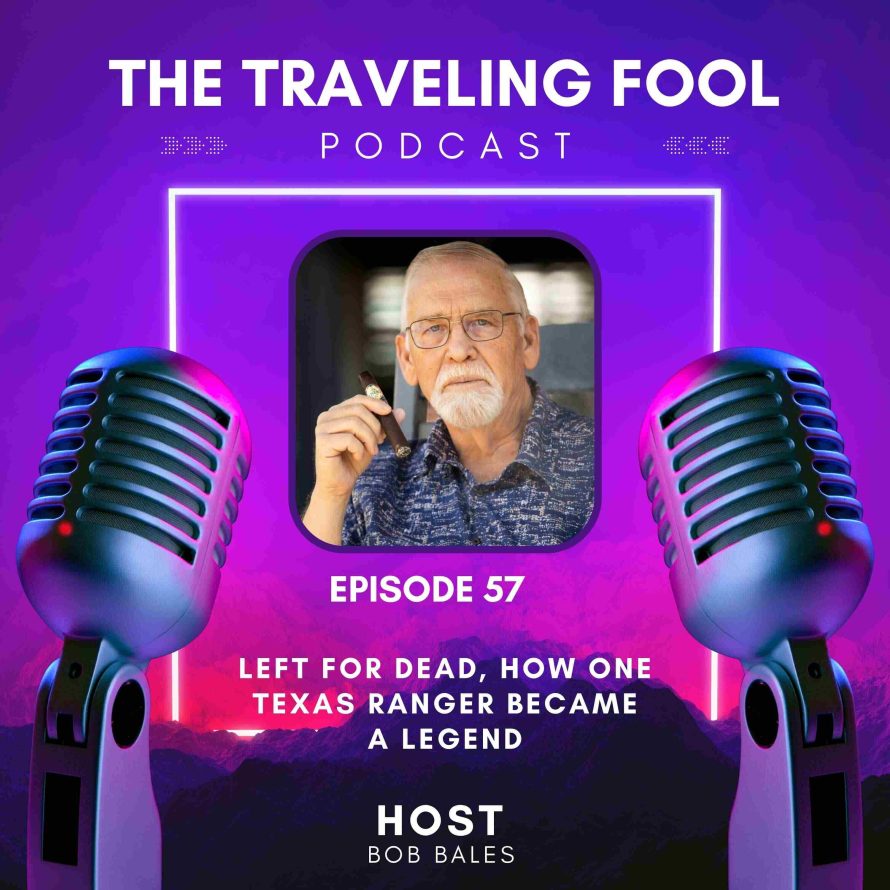
Wounded, no food, no water, no weapon. A young Texas Ranger wakes up on the ground near the Nueces River, realizes everyone has left him for dead, makes a decision that turns him into a legend.
TRANSCRIPT
Hi, and welcome to The Traveling Fool, the show where we talk about travel destinations and the history and culture around those destinations. I’m your host, Bob Bales, and today we are talking about one of the toughest men in Texas. Starting as a teenager, he built a reputation that would become a whispered legend by the time he died. So stay tuned and we’ll be right back.
Before we get started please hit that like or subscribe button I would appreciate it. You can also head over to the website, Thetravellingfool.com and sign up for the monthly newsletter. It goes out once a month and it contains the latest in travel news and contests where you might be able to win a trip somewhere.
Rufus Perry Origins And Early Ranger Life
Okay, let me tell you about Rufus. That’s right. Born in Alabama, he was given the first name of Cicero and the middle name of Rufus. At a young age, he moved with his family to Texas and settled around Bastrop, Texas. Soon, with Texas independence brewing and the Mexican army moving east, his father evacuated the family to safety and his father joined up with General Sam Houston and the Texan Army. And young Rufus? Well, he went along with him. Soon, Rufus was running dispatches for Sam Houston and experiencing battles firsthand.
In 1836, at the tender age of thirteen, he joined the newly formed Texas Rangers and was involved in skirmishes with some of the Native American tribes in Texas. He continued to ride as a Texas Ranger, serving as a scout when in 1844 his unit engaged with a Comanche party on the Nueces River.
Ambush On The Nueces River
It was here that Cicero Rufus Perry became a legend. While standing guard for a Ranger Patrol that was out searching for horse thieves, the Comanches attacked without warning. The first arrow struck him in the shoulder, and then another one in his stomach, while a third arrow hit him in his temple, collapsing on the ground he passed out from his wounds.
When he awoke, he was surrounded by Comanches checking to see if he was dead. Lying very still, the Comanches left him, and when he looked around the other rangers had left him as well, thinking he was dead and they were fleeing the Comanches.
The 120 Mile Survival Walk
Bleeding from three serious wounds, twenty two year old Perry began to crawl. It took him hours to crawl just a couple hundred yards to the Nueces River where he drank and rested. He pulled the arrow from his shoulder and the one from his stomach, but the arrow in his temple was buried to the bone.
It was then he decided he was not going to give up and he was going to walk to San Antonio. Perry began the one hundred twenty mile journey with no food, no water, and no weapon through hostile territory filled with Comanches. After the first three miles he collapsed, and when he gained consciousness, he started walking again. Over the next day and a half he managed to walk ten miles. Walking, sometimes crawling, he managed to keep going, scavenging for anything he could to eat and drinking from the streams until the seventh day, when at dusk, Cicero Perry stumbled into San Antonio, with people staring at this walking corpse covered in dried blood with an arrow protruding from his temple.
He looked like he had risen from the dead. His ranger companions who had left thinking he was dead were ready to ride out and bury his body. Perry was rushed to the doctor, who carefully removed the arrow from his temple, and it took Perry three months to recover. And then he surprised everyone by going back to work as a ranger.
Decades Of Battles And Final Resting Place
He continued riding with the rangers for four more decades. He fought in the Battle of Deer Creek in 1873. He rose to captain of Company D, commanding men who looked at his scars and knew that this man had walked through hell and come back. Over his career, Perry fought in three wars, sustained twenty wounds from arrows and lances, and seven more from bullets, twenty-seven total, and became a legend. On October 8th, 1898, Captain Rufe Perry died at home and was buried in Johnson City, Texas, in the Masonic Cemetery, leaving a lasting legacy as one tough Texas Ranger.
Johnson City Travel Guide And History Stops
Now Johnson City lies roughly halfway between Austin and Fredericksburg, Texas on Highway 290. Founded and named for James P. Johnson, the uncle of Lyndon B. Johnson, the 36th President of the United States.
You can visit the former President Boyhood home, which is part of the Lyndon B. Johnson National Historic Park, explore Johnson’s settlement where his family farmed, and see his ranch that was nicknamed the Texas White House. When he was in office, he welcomed leaders from around the world and exposed them to some Texas life. The park has free admission, and it’s a great way to spend a half a day learning all about his family’s history.
While you’re there, there is also the Sauer Beckman Living History Farm where costumed interpreters bring turn of the century hill country to life seven days a week. This immersive experience has park staff in period clothing who tend animals, cook over wood burning stoves, and carry out the daily rhythms of early Texas rural life. You can watch a blacksmith at work feed the chickens or pull up a chair and hear what it was like to homestead in the Texas hill country more than a century ago.
Pedernales Falls State Park is also located in Johnson City where the Pedernales River flows over huge limestone slabs and offers biking trails, birding, camping, fishing, hiking. You can go stargazing. I mean, when you get out in the hill country, you want to see some stars? Nothing like leaving the city and getting out in the country to do it. And you can go swimming in the state park. It’s both kid and pet friendly, bring your dogs.
While you’re in Johnson City, I would check out the Texas Vintage Motorcycle Museum with over 100 restored vintage motorcycles, including a 1931 Harley Davidson and a rare BMW from the 1960s, along with racing bikes. A lot more in a restored 6,500 square foot 1930s era Model A Ford Showroom.
While you’re there, check out Garrison Brothers Distillery, the first and oldest legal whiskey distillery in the state of Texas. It’s located in Johnson City, and you can stop by, take a tour, and do a whiskey tasting. There’s also Untamed Wine Estate located there as well, and they have a tasting room and wood fired pizza to go along with your wine. Plus, you can take a tour and check out how they produce their wines. There are several other wineries nearby and in Fredericksburg as well, and wine bars all over the place that serve up Texas wines and some really good food.
There are also several boutique and antique stores along with some really good places to eat in Johnson City, like Pig Pen Barbecue or Brian’s on 290, and the Local Bull, which is a tap room, ranch kitchen, and meat market. While you’re there, check out Proof and Cooper’s at the lumberyard for barbecue, fried chicken and burgers while you sip some whiskey or have a cold beer.
Now Johnson City is considered the gateway to the hill country, and the small town offers a lot to see and do, and it’s a great place to visit for the weekend. And while you’re there, well don’t forget to stop by the Masonic Cemetery and pay your respects to Captain Ruth Perry, one of the toughest men in Texas, and one tough Texas Ranger.
Closing Thanks And Subscribe Request
Well, that’s it for this week. But before I go, please hit that like or subscribe button and send a link to the podcast to someone you think might enjoy it. And until next time, safe travels.
Please subscribe and leave a review on I-Tunes.
You can sign up for my email list
Follow me on social media





Leave a Reply